Quick answer
Our overall pick for the best toddler counting toys is the Learning Resources Smart Snacks Counting Cookies for its realistic, hands-on play that builds number skills. Other picks include a portable wooden ladybug set, a classic peg board for visual counting, and a colorful bead game that develops fine motor skills alongside counting.
Finding toddler counting toys can help your child build a strong foundation for early math skills through play. We looked at manufacturer listings and specifications to compare features, materials, and educational aspects.
These toys are designed to make learning numbers fun, often combining counting practice with imaginative play or fine motor skill development. The right toy can grow with your child, from simple number recognition to more complex early math concepts.
Quick picks
- Best for pretend play: Learning Resources Smart Snacks Counting Cookies (see on Amazon)
- Best portable set: Kenley Counting Ladybugs (see on Amazon)
- Best for visual counting: Suwimut Wooden Counting Peg Board (see on Amazon)
Best Toddler Counting Toys compared
| # | Product | Best for | Material | Number of Pieces | Storage Included |
|---|---|---|---|---|---|
| 1 | Learning Resources Smart Snacks Counting Cookies | Our overall pick | Plastic | 11 Pieces | Yes (cookie jar) |
| 2 | Kenley Counting Ladybugs | Best for on-the-go learning | Wood, Felt | 11 ladybugs listed | Yes (felt jar with strap) |
| 3 | Suwimut Wooden Counting Peg Board | Best for mastering one-to-one correspondence | Wood | 65+ pieces (10 boards, 55 pegs) | Yes (canvas drawstring bag) |
| 4 | WECHARM KIDS Fine Motor Peg Board | Best for combining counting with fine motor practice | Wood, ABS plastic | 56 beads + accessories | Not listed |
How we chose
We compared manufacturer listings and specifications on Amazon as of October 2026. We did not test these products hands-on. Our picks are based on comparing stated features, materials, size, and intended educational benefits.
We focused on toys that clearly support counting and number recognition, are made from child-friendly materials, and offer durability and engaging play for toddlers.
Best Toddler Counting Toys: our picks in detail
1. Our overall pick: Learning Resources Smart Snacks Counting Cookies

Pros
- Combines number learning with imaginative kitchen play
- Sturdy plastic jar and cookies designed for small hands
- Helps develop fine motor skills and hand-eye coordination
- Versatile toy that can grow with your child's skills
Cons
- The listing does not mention if the paint or materials are non-toxic
- Plastic construction may not appeal to those seeking natural materials
The Learning Resources Smart Snacks Counting Cookies set includes 11 realistic-looking plastic cookies numbered 0-10 with matching chips inside a sturdy plastic cookie jar. The listing states it helps build number recognition and counting skills through hands-on play.
This toy is designed to combine learning with imaginative play, making it a great addition to play kitchens. The easy-open jar and right-sized cookies are proportioned for small hands, helping develop fine motor skills as children take cookies in and out. The listing suggests it grows with your child from simple container play to counting and early math activities.
Best for: Toddlers who enjoy pretend play and need a durable, familiar object to learn numbers.
2. Best for on-the-go learning: Kenley Counting Ladybugs
Pros
- Made from natural wood and soft felt materials
- Includes a portable storage jar with a shoulder strap
- Encourages tidying up and imaginative play
- Designed for hands-on learning of numbers 0-10
Cons
- The listing does not mention the exact number of pieces beyond the 11 ladybugs
- Felt storage jar may require more careful cleaning
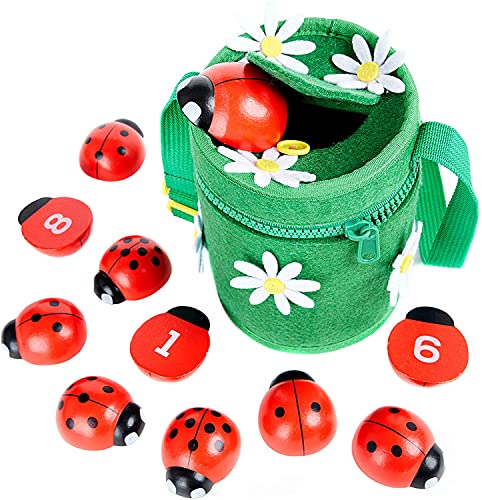
The Kenley Counting Ladybugs set is a Montessori-inspired wooden counting toy that includes 11 ladybugs and a soft felt carrying jar with a zip and an adjustable shoulder strap. The ladybugs are made from natural wood with child-safe paint.
This set is designed to be a tactile and fun way for kids to learn numbers 0-10. The felt jar provides a home for the bugs, encouraging both imaginative play and tidying up. The listing states it helps build foundations for advanced math skills through hands-on counting and simple math games.
Best for: Families looking for a portable, natural material counting toy that encourages tidy-up habits.
3. Best for mastering one-to-one correspondence: Suwimut Wooden Counting Peg Board

Pros
- Teaches one-to-one correspondence between numbers and quantities
- Includes a large number of pieces (55 pegs, 10 boards) for extended play
- Made from non-toxic wood with water-based paint
- Comes with a drawstring bag for easy storage and portability
Cons
- With many small pieces, close supervision is required
- The listing does not specify the exact dimensions of the boards
The Suwimut Wooden Counting Peg Board is a double-sided, 2-in-1 Montessori educational toy. It includes 10 wooden number boards, 55 wooden pegs, and a canvas drawstring bag for storage. The pegs are brightly colored.
This toy is designed to build early recognition of counting, shape, color, and size. The peg board features holes that correspond with the number on each board, introducing the concept of one-to-one correspondence. The listing states it is crafted from high-quality non-toxic wood with water-based paint.
Best for: Preschoolers ready to visually connect numbers with quantities in a structured, Montessori-style activity.
4. Best for combining counting with fine motor practice: WECHARM KIDS Fine Motor Peg Board
Pros
- Combines counting, color sorting, and fine motor skill development
- Includes many accessories for varied play (templates, cups, spoon)
- Wooden pieces are sanded smooth for safety
- Bright, engaging colors to maintain toddler interest
Cons
- Contains many small parts requiring close supervision
- The listing does not mention if the paints or dyes used are non-toxic
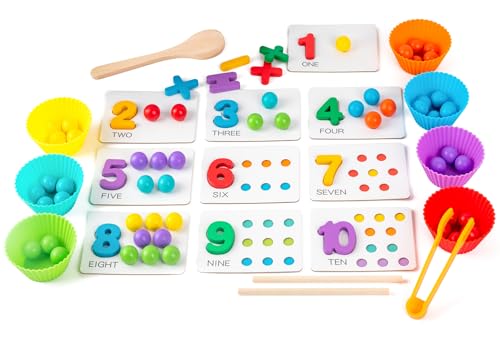
The WECHARM KIDS Fine Motor Peg Board is a rainbow-colored bead game that includes a peg board, 56 wooden beads in 7 colors, 10 picture templates, and accessories like cups, a clip, and a spoon. The wooden components are sanded smooth.
This toy is designed to boost fine motor skills, color recognition, and counting. The listing states it sparks creativity as children press, clip, and arrange beads to create drawings or follow templates. It includes math games like counting beads and color sorting, intended for screen-free fun.
Best for: Toddlers who need a highly engaging, multi-activity toy that develops fine motor skills alongside early math concepts.
How to choose toddler counting toys
When looking for toddler counting toys, the goal is to find a toy that makes learning numbers fun and matches your child’s developmental stage. A good counting toy should be engaging enough to hold their attention while introducing basic math concepts through play.
Consider how the toy will be used. Some counting toys integrate seamlessly into pretend play, like a cookie jar for a play kitchen, while others are more focused on structured learning, like peg boards that match numbers to quantities. Think about your child’s interests and whether they learn best through storytelling, hands-on manipulation, or visual puzzles.
What to look for
- Material and Safety: Look for toys made from durable, child-safe materials. Wooden toys should have smooth, sanded edges, and any paints or finishes should be non-toxic. Always check the manufacturer’s specifications for material claims.
- Educational Aspects: Toddler counting toys do more than just recite numbers. They help build skills like one-to-one correspondence (matching one object to one number), fine motor control, color recognition, and even early addition and subtraction concepts.
- Engagement and Play: A toy that grows with your child offers more versatility. Look for toys that can be used for simple number recognition now and for more complex games later. Toys that combine counting with other types of play, like sorting or imaginative scenarios, often have longer-lasting appeal.
- Storage and Portability: Toys with many pieces benefit from included storage, like a jar or bag. This helps with clean-up and makes the toy easy to take on the go, which is great for learning during travel or outings.
Remember, the best learning happens through positive, playful interactions. For more ideas on incorporating math into daily life, see our article on Fun Counting Activities for Toddlers Using Everyday Objects. You can also explore our full category of Counting Activities for more inspiration.
FAQ
What age are counting toys appropriate for?
Many counting toys are designed for children around 18 months to 3 years old and up, as this is when toddlers begin to recognize numbers and quantities. The listings we compared often specify ages 3+, but some, like the cookie jar, mention starting with simple container play at 18 months. Always check the manufacturer’s age recommendation and supervise play, especially with small parts.
How do counting toys help with toddler development?
According to the product listings, these toys support several areas of development. They build early math skills like number recognition and counting. They also develop fine motor skills and hand-eye coordination as toddlers grasp, place, and sort pieces. Furthermore, toys that encourage pretend play or sorting also support cognitive development, creativity, and problem-solving. For a broader look at skill-building play, visit our guide on Learning Activities for Toddlers.
Are wooden or plastic counting toys better?
Both materials have pros and cons, and the “best” choice depends on your priorities. The listings show wooden toys are often valued for their natural feel and durability, while plastic toys can be very durable, lightweight, and easy to clean. The key is to look for non-toxic, child-safe materials in either category, as stated by the manufacturer.
What should I do if a piece from a counting toy is lost or broken?
First, check the manufacturer’s website or contact them directly for replacement part policies, as this varies by brand. For safety, if a toy breaks creating sharp edges or small, hazardous pieces, it should be removed from play immediately. To prevent loss, use the storage included with many sets and establish a clean-up routine with your toddler after playtime.
References
- Amazon product listings and manufacturer specifications (accessed October 2026)
- Counting Activities – Toddler Daddy
- Fun Counting Activities for Toddlers Using Everyday Objects – Toddler Daddy
- Learning Activities for Toddlers: Colors, Shapes, Counting and Language Games – Toddler Daddy