Quick answer
Our overall pick is the Educational Insights GeoSafari Kidnoculars, which lists a focus-free design, an extra-large 2x eyepiece and a breakaway neck strap. Models with 8x or 6.5x power suit older toddlers ready for more magnification, while the guide, compass and carry-bag sets suit gift buyers and families who want extras.
Shopping for the best binoculars for toddlers means reading past the marketing and checking what each listing actually states: magnification, weight, focus style, eyepiece and grip design, and the age range. Many kids’ binoculars are sold for a wide age span, so the listed ages matter as much as the size. This roundup covers 12 models sold on Amazon for young children, arranged so you can match a pair to your child’s age and the outings you have in mind.
Binoculars are a natural fit for outdoor play, from spotting birds in the backyard to walks at the park. For more ideas, browse our Outdoor Learning category, read our guide to easy outdoor science activities for curious toddlers, or see Outdoor Activities for Toddlers for backyard, playground and nature walk ideas.
Quick picks
- Focus-free start with a neck strap: Educational Insights GeoSafari Kidnoculars (see on Amazon)
- 8x power with a bird sticker book: Noptix Real Kids Binoculars 8×21 (see on Amazon)
- Bird-spotting manual included: LET’S GO! Pink Bird Watching Binoculars (see on Amazon)
- Carry bag and strap bundle: Scotamalone 4×30 Kids Binoculars Set (see on Amazon)
12 Best Kids Binoculars compared
| # | Product | Best for | Color | Weight | Magnification |
|---|---|---|---|---|---|
| 1 | Educational Insights GeoSafari Kidnoculars | Best overall | Green | 0.44 lb | 2x |
| 2 | Dan&Darci My First Binoculars | Best for a simple, no-focus start | Multicolor | Not listed | 2X |
| 3 | LET’S GO! Compact Kids Binoculars Orange | Best for a shock-absorbing rubber coating | Orange | 0.40 lb | Not listed |
| 4 | Noptix Real Kids Binoculars 8×21 | Best for an 8x pair with a sticker book | Green Blue | 0.57 lb | 8×21 |
| 5 | Vortex Bantam HD 6.5×32 Youth | Best for adult-style HD optics | Green | 0.99 lb | 6.5x |
| 6 | OBUBY 8×21 Real Kids Binoculars | Best for a wide field of view | Blue | 0.37 lb | 8x |
| 7 | BeBison 8×21 Kids Binoculars | Best for a metal mount | Orange | 0.48 lb | 8×21 |
| 8 | Think Peak Green Kids Binoculars | Best for small hands and swivel barrels | Green | 0.55 lb | 8×21 |
| 9 | Scotamalone 4×30 Kids Binoculars Set | Best for a carry-bag bundle | Blue | 0.23 lb | 4×30 |
| 10 | LET’S GO! Pink Bird Watching Binoculars | Best for bird-spotting with a guide | Pink | 0.37 lb | 4×30 |
| 11 | ARTOMIDE Kids Binoculars with Compass | Best for a compass and whistle | Blue | 0.33 lb | 5x |
| 12 | JovialToyz Kids Binoculars with Compass | Best for holiday gift-giving | Red | Not listed | Not listed |
How we chose
We compared manufacturer listings and specifications on Amazon as of November 2026. Our picks come from reading those listings side by side, not from hands-on testing, so every fact in this article comes from the listing data.
Because the best binoculars for toddlers depend on age and use, we looked at the details a parent can check on a listing: stated magnification, weight, focus style (focus-free or adjustable), eyepiece and grip design, shock resistance, included extras such as neck straps or guides, and whether the age range is clear and consistent. Where a listing contradicted itself, such as a title age range that differs from its features, we say so. Where a spec figure looked implausible, we left it out.
Starter pairs for the youngest explorers
Focus-free or simple designs with grips described for small hands.
1. Best overall: Educational Insights GeoSafari Kidnoculars

Pros
- Focus-free design per the listing
- Breakaway neck strap and extra-large eyepiece
- Listed for backyard, park and camping use
Cons
- Magnification is listed at 2x, lower than the 8x models here
- Title says ages 4-8 while features say ages 3 and up
The GeoSafari Kidnoculars are described as sturdy, portable binoculars designed for toddlers. The listing calls them focus-free, lists an extra-large 2x eyepiece and a breakaway neck strap, and says they are for children ages 3 and up. Features highlight bird watching in the backyard, park visits and stargazing on camping trips. The listed color is green.
Best for: Best for a first pair that needs no focusing and comes with a breakaway neck strap.
2. Best for a simple, no-focus start: Dan&Darci My First Binoculars

Pros
- Focus-free, with no wheels to adjust
- Soft viewing areas and an easy-grip shape
- Listed as durable and drop-resistant
Cons
- The listing does not mention a neck strap
- Weight is not listed
The Dan&Darci binoculars are presented as a first pair for little explorers, with 2X magnification and a focus-free design. The listing says there are no complicated adjustments or focusing wheels. Soft viewing areas and an easy-grip shape are described for smaller hands. The listing calls them durable and drop-resistant and lists uses from backyard play to camping and sporting events.
Best for: Best for a child who is brand new to binoculars and needs nothing to adjust.
3. Best for a shock-absorbing rubber coating: LET’S GO! Compact Kids Binoculars Orange

Pros
- Rubber-surrounded eyepieces and non-slip grip
- Rubber coating described as shock absorbing
- Listed weight of about 0.40 pounds
Cons
- Magnification is not listed
- The listing does not mention a neck strap
This LET’S GO! model is described for boys ages 3 to 6 and comes in orange. It has soft rubber-surrounded eyepieces for eye protection and a non-slip grip that the listing says is ergonomically designed for kids’ hands. A rubber coating is described as absorbing shock if the set is dropped. The optics are described as green-coated, and the listed size is small.
Best for: Best for a child who drops things often and needs a compact pair with a rubber coating.
Stronger magnification for older kids
Models with 6.5x or 8x power listed, each with different focus and build details.
4. Best for an 8x pair with a sticker book: Noptix Real Kids Binoculars 8×21

Pros
- 8x21 magnification with roof prism construction
- Soft non-toxic rubber grip and flexible eye cups
- Includes a 40-bird sticker book per the title
Cons
- Title says ages 4-8 while features say ages 3+
- The listing does not mention a neck strap
Noptix lists these as 8×21 binoculars with roof prism construction and lens coatings, designed for kids ages 3 and up. The body is described as shockproof, with a soft non-toxic rubber grip and flexible eye cups. The features say the focus is easy to adjust. The title notes an included 40-bird sticker book, and the listed color is green blue.
Best for: Best for an older toddler who wants stronger magnification and a bird sticker book to go with it.
5. Best for adult-style HD optics: Vortex Bantam HD 6.5×32 Youth

Pros
- HD optics with XR lens coatings and 6.5x power
- Tripod adaptable and eyeglass friendly
- Waterproof, fogproof and shockproof per the listing
Cons
- Weight is listed at about 0.99 pounds, the highest in this roundup
- The listing does not mention a neck strap
The Vortex Bantam HD is listed as a youth binocular with 6.5x magnification, an HD optical system and XR lens coatings. The listing describes it as tripod adaptable and eyeglass friendly, with waterproof, fogproof and shockproof features. Controls are described as simple to use, and the shape is ergonomic for youth hands and faces. The listed color is green and the size is 6.5×32.
Best for: Best for a family that wants full HD-style optics for an older child and plans to add a tripod.
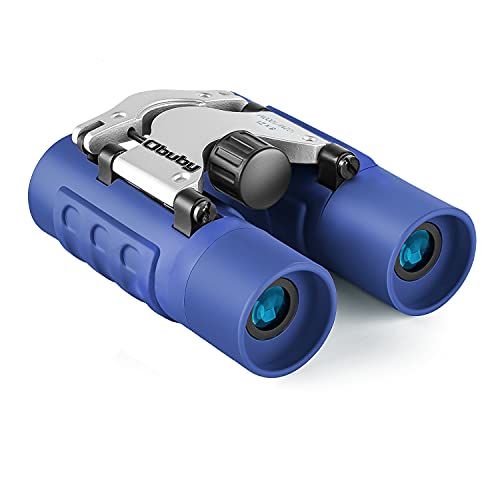
6. Best for a wide field of view: OBUBY 8×21 Real Kids Binoculars
Pros
- 8X magnification with a 7.2 degree viewing angle
- Center knob adjusts to eye distance
- Rubber-armored exterior for shock protection
Cons
- Body is polycarbonate plastic per the listing
- The listing does not mention a neck strap
OBUBY lists these blue binoculars at 8X magnification with a 7.2 degree viewing angle, which the listing says gives children a wide field to scan. The center knob adjusts to eye distance, and the optics use a BAK 4 FMC prism with green multi-layer coating. Soft rubber surrounds the eyepieces, and the exterior is described as polycarbonate plastic with rubber armor.
Best for: Best for a child who wants a wide view of birds and scenery with 8x power.
7. Best for a metal mount: BeBison 8×21 Kids Binoculars

Pros
- Metal mount for added durability
- 8x21 compact, folding and shockproof design
- Soft rubber eyepieces and rubber exterior
Cons
- Brand field reads Scotar while the title says BeBison
- Age range appears only in the features, not the title
The BeBison binoculars are presented as 8×21 compact, folding and shockproof kids binoculars in orange. The listing highlights a metal mount for added durability, along with a rubber exterior and soft rubber eyepieces. The features describe them as suitable for kids and teens new to binoculars, with ages 4 and up noted. Listed uses include hiking, birding and concerts.
Best for: Best for a child or teen who is new to binoculars and wants a metal-mounted build.
8. Best for small hands and swivel barrels: Think Peak Green Kids Binoculars

Pros
- Swivel barrels and textured rubber focus knob
- Shock-resistant body with breakaway neck strap
- 8x21 BAK4 lenses per the listing
Cons
- Uses a center focus knob, so it is not focus-free
- The 3 to 12 age range is wide
Think Peak lists green 8×21 binoculars with BAK4 lenses, marketed for ages 3 to 12. The barrels swivel easily, the center focus knob is covered in textured rubber, and the body is described as shock resistant. The listing mentions a breakaway neck strap. The binoculars are listed as measuring 4 by 4 inches, with eyepieces sized 1.5 inches.
Best for: Best for a child with small hands who will adjust the focus knob with a parent’s help.
Kits with guides, compasses and carry extras
Sets that include a guide, compass, bag or strap alongside the optics.
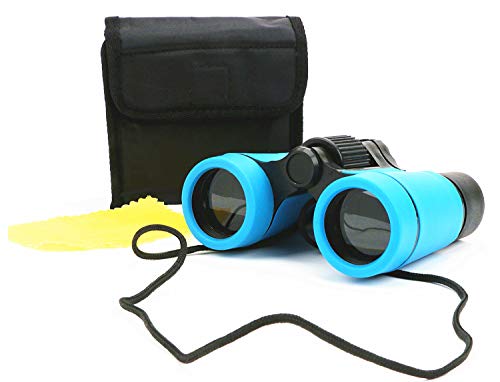
9. Best for a carry-bag bundle: Scotamalone 4×30 Kids Binoculars Set
Pros
- Includes carrying canvas bag, neck strap and lens cloth
- Adjustable eye distance knob
- Nontoxic natural rubber body described
Cons
- Only 4x magnification is listed
- The 3 to 12 age range is wide for one design
The Scotamalone set is a 4×30 pocket-sized pair in blue with an adjustment knob for eye distance. The listing calls the rubber-surrounded eyepieces and natural rubber body nontoxic. The box includes a carrying canvas bag, a neck strap and a lens wiping cloth. The set is described as suitable for ages 3 to 12 and for activities from bird watching to car trips.
Best for: Best for a gift set where the carry bag, neck strap and lens cloth are included in one box.
10. Best for bird-spotting with a guide: LET’S GO! Pink Bird Watching Binoculars

Pros
- Bird watching manual covering 17 species
- Non-slip handle and small, light build
- Materials described as safe and nontoxic
Cons
- Title age range of 3-7 differs from features age of 4-7
- The listing does not mention a neck strap
This pink LET’S GO! set is sized 4×30 and is aimed at children ages 3 to 7 in the title and 4 to 7 in the features. Its distinguishing extra is a bird watching manual that the listing says covers 17 common North American bird species. The handle has a non-slip design, and the listing describes the materials as safe and nontoxic.
Best for: Best for a child who wants to identify birds and has a guide to help.
11. Best for a compass and whistle: ARTOMIDE Kids Binoculars with Compass

Pros
- Compass and whistle listed in the title
- Soft rubber eyepieces and rubber-armored housing
- Folding design adjusts to eye distance
Cons
- Housing is polycarbonate plastic and rubber per the listing
- The listing does not mention a neck strap
ARTOMIDE lists blue kids binoculars for ages 3 to 12 with a compass and whistle. The listing describes 5x magnification, a large field of view and a folding design that can be adjusted to eye distance. Soft rubber surrounds the eyepieces, and the housing is described as polycarbonate plastic with rubber armor that absorbs shock during drops.
Best for: Best for a child who likes to navigate and signal while exploring outdoors.
12. Best for holiday gift-giving: JovialToyz Kids Binoculars with Compass

Pros
- Sensitive compass and bird watching manual
- Non-slip handle for a firm grip
- Presented as a gift for birthdays and holidays
Cons
- Title age range of 3-8 differs from the features' 4-8
- Weight and magnification are not listed
JovialToyz lists red compact binoculars for ages 3 to 8 in the title, with a sensitive compass and a bird watching manual. The listing says the non-slip handle keeps a firm grip and that the materials are nontoxic. The features also present the set as a birthday, Halloween or Christmas gift for young adventurers.
Best for: Best for a gift for a young child who will use a compass and bird guide on outings.
How to choose the best binoculars for toddlers
Start with age. Listings in this roundup range from simple focus-free pairs to models with adjustable focus and higher magnification. The listed age range is a helpful guide, but check that the title and features agree, since several listings here do not.
Next, look at magnification. Focus-free starter pairs tend to list low power, while higher numbers appear on models with adjustable focus. Higher power is not automatically better for a small child. Compare it with the design details, such as eyepiece size and grip, before deciding.
Check the handling details. A non-slip or soft rubber grip, rubber-surrounded eyepieces and a body described as shockproof or drop-resistant all matter for small hands. Note whether the listing includes a breakaway neck strap, which some models here list and others do not mention. Weight matters too, and listed weights in this roundup run from light to just under one pound.
Consider extras. Some sets include a carrying bag, a neck strap, a lens cloth, a bird watching manual or a compass. These can make a set more useful for outdoor learning, but they do not change the optics themselves.
Safety comes first. Supervise young children during play, follow the manufacturer’s manual for care and use, and keep small accessories away from children who still mouth objects. For general guidance on child health and safety, the HealthyChildren.org site is a good reference. To plan simple outings, see our outdoor activities guide.
What to look for
- A clearly stated age range that matches your child
- Listed magnification and whether focus is adjustable or focus-free
- Soft rubber grip, rubber-surrounded eyepieces and a shockproof body
- A breakaway neck strap or carrying case, if listed
- Listed weight and size that suit small hands
FAQ
What age are these binoculars for?
Listings in this roundup state different age ranges, with some starting at 3 and others at 4. Check the age in both the title and the features, because a few listings show different ages in each. Follow the manufacturer’s manual for use and supervise young children at all times.
Is more magnification better for a toddler?
Not always. Higher magnification appears on several models here, but grip, eyepiece design and focus style also shape how easy a pair is to use. Start with the design features that suit your child, then compare the power.
Do I need a focus-free pair?
Focus-free designs are described on some listings as easy to look through without wheels or adjustments, which can suit a first pair. If a listing has an adjustable center focus knob, the manufacturer’s manual explains how to use it. Either way, the best binoculars for toddlers are the ones matched to your child’s age and the outings you plan.
Should binoculars come with a neck strap?
A breakaway neck strap is listed on several models here. Where a listing does not mention a strap, check before you buy. Always follow the manufacturer’s manual for fitting and using any strap, and keep cords away from young children during play.
References
- Amazon product listings and manufacturer specifications (accessed November 2026)
- HealthyChildren.org, American Academy of Pediatrics