Quick answer
Our overall pick is the JBL Junior 470NC, which lists an 85dB maximum volume and parental controls for volume and daily listening time. Wireless sets suit travel and playdates, while wired sets suit simple school use.
Finding the best kids headphones for a toddler or preschooler comes down to volume limits, a comfortable fit and a connection that works for your routine. Headphones can also become a source of frustration when they pinch, slip or stop working mid-show, so we looked closely at the details. For background on why small kids melt down, read Toddler Tantrums: Why They Happen and How to Respond and browse the Toddler Tantrums category.
Quick picks
- Parental volume controls: JBL Junior 470NC (see on Amazon)
- Long wireless playtime: EarFun K2 Kids Bluetooth (see on Amazon)
- Light-up fun for travel: iClever P550 LED (see on Amazon)
- Wired school setup: JBL Junior 320 (see on Amazon)
- Study or travel volume modes: Botesty Sound Kids (see on Amazon)
16 Best Kids Headphones compared
| # | Product | Best for | Color | Weight | Connection |
|---|---|---|---|---|---|
| 1 | JBL Junior 470NC | Best overall | White | 0.43 lb | Not listed |
| 2 | EarFun K2 Kids Bluetooth | Long playtime between charges | Blue | 0.39 lb | Bluetooth 5.4 |
| 3 | JoySpark Kids Bluetooth | Backup audio jack | Purple | 0.37 lb | Bluetooth 5.3 with 3.5mm backup jack |
| 4 | Acer OHR668 Foldable | Reinforced foldable frame | Purple Green | 0.42 lb | Bluetooth 6.0 |
| 5 | Belkin SoundForm Mini | Touch controls and USB-C | Blue | Not listed | Wireless (Bluetooth 5.0) and wired (3.5mm AUX) |
| 6 | iClever P550 LED | Light-up LED design | A-Pink | 0.35 lb | Bluetooth 6.0 |
| 7 | QearFun Cat Ear | Character-style designs | Cat Pink | Not listed | Bluetooth with wired mode |
| 8 | Midola ANC Kids | Noise cancellation | Deep Blue | Not listed | Wireless |
| 9 | eKids Spider-Man | Licensed Spider-Man styling | Spiderman | Not listed | Bluetooth with 3.5mm cable option |
| 10 | iClever BTH22 | Rotating ear cups and headband | A-Blue | 0.33 lb | Bluetooth 5.4 |
| 11 | JBL Junior 320 | Customizable stickers | Purple | 0.26 lb | Wired (3.5mm) |
| 12 | EarFun K1 Wired | Tangle-resistant braided cord | Black Red | 0.44 lb | Wired (3.5mm) |
| 13 | Acer HK03 Wired | Universal 3.5mm compatibility | Purple Green | 0.33 lb | Wired (3.5mm) |
| 14 | iClever HS19 | Share port for a second listener | Blue | 0.38 lb | Wired (3.5mm) |
| 15 | Aechorhy Over Ear | HD mic on a cord | Purple-Pink | Not listed | Wired (3.5mm) |
| 16 | Botesty Sound Kids | Study or travel volume modes | Navy Blue | 0.40 lb | Wired (3.5mm) |
How we chose
We compared manufacturer listings and specifications on Amazon as of November 2026. We did not test any product by hand. Each pick is based on what the listing states: volume limits, connection type, battery claims, weight, fit adjustments and included features. We left out spec values that looked wrong for the product, such as weights that did not match the listing.
Where a detail was missing or unclear, we marked it ‘Not listed’ rather than guessing. The best fit for your child depends on their size, listening habits and the device you plan to use.
Our overall pick
Our top choice combines a stated volume ceiling with parental controls for volume and listening time.
1. Best overall: JBL Junior 470NC

Pros
- 85dB maximum with an adjustable lower limit
- Parental controls for volume and daily listening time
- Active noise cancelling listed
Cons
- The listing does not mention battery life or connection type
The JBL Junior 470NC is designed to never exceed 85dB, and its automatic maximum can be lowered in the settings. Parental controls let adults customize maximum volume and daily listening time. The listing also highlights active noise cancelling and a white finish.
Best for: Families who want volume limits, daily listening controls and noise cancelling in one set.
Wireless picks for school and travel
These sets list Bluetooth or wireless connections, so they suit kids who move around, travel or take calls.
2. Long playtime between charges: EarFun K2 Kids Bluetooth

Pros
- Three volume limits: 74, 85 and 94dB
- 60-hour playtime listed in the title
- Built-in mic for hands-free calls
Cons
- The listing does not mention a carrying case
The EarFun K2 offers volume limits of 74, 85 and 94dB, a built-in microphone for hands-free calls and Bluetooth 5.4. Its title lists 60-hour playtime, and 40mm drivers provide stereo sound. Soft memory foam earpads and a headband are described for comfort, and the headphones fold.
Best for: Kids who use headphones on long car rides or for extended listening between charges.
3. Backup audio jack: JoySpark Kids Bluetooth

Pros
- Fully adjustable headband
- 3.5mm backup jack listed
- One-button controls for play, pause and calls
Cons
- Size is listed as 'Adjustable' with no fit dimensions
The JoySpark kids headphones use memory foam ear cushions and a fully adjustable headband, with a built-in 40mm speaker unit. Bluetooth 5.3 pairs with a one-button control for play, pause and calls. A 3.5mm backup jack gives a wired option when you prefer a cord.
Best for: Families who want a wireless set that can also switch to a cord.
4. Reinforced foldable frame: Acer OHR668 Foldable

Pros
- Reinforced headband hinge listed
- 85/94dB volume limiting
- Bluetooth 6.0 with built-in mic
Cons
- The listing does not mention a wired cable option
The Acer OHR668 lists 85/94dB volume limiting, a reinforced headband hinge and a foldable design. Its memory foam ear cushions and adjustable headband are described for all-day comfort. Bluetooth 6.0 handles wireless streaming, and a built-in mic is listed for voice calls.
Best for: Kids who carry headphones in bags and want a frame built to handle rough handling.
5. Touch controls and USB-C: Belkin SoundForm Mini
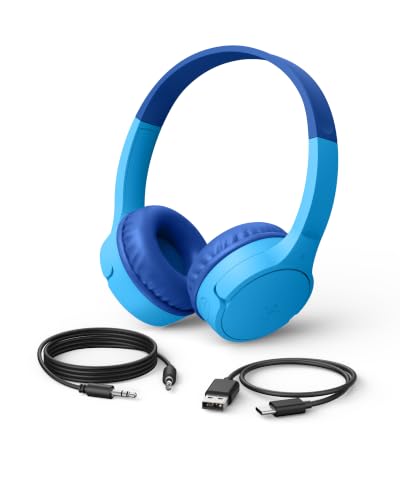
Pros
- Wireless and wired options
- Touch controls on the headphones
- USB-C charging listed
Cons
- The listing does not give a weight
The Belkin SoundForm Mini works wirelessly over Bluetooth and by wire through a 3.5mm AUX port. The listing describes up to 30 hours of battery life, an 85dB volume limit and touch controls for play, pause and volume. It charges through a USB-C port.
Best for: Kids who prefer tapping the headphones over using buttons on a cord or phone.
6. Light-up LED design: iClever P550 LED

Pros
- Two volume limits: 74dBA and 85dBA
- LED lights built into the design
- 48-hour playtime listed with lights off
Cons
- Light-on playtime is not stated
The iClever P550 has a built-in LED light show and two volume limits, 74dBA for a gentler mode and 85dBA for fuller sound. Bluetooth 6.0 handles the wireless connection, and USB-C charging is listed with an AUX cable mentioned. Rotatable over-ear cups and a foldable frame are described.
Best for: Kids who want a playful look for road trips, flights and playdates.
7. Character-style designs: QearFun Cat Ear

Pros
- Character choice: dino, cat or unicorn
- Three parent-controlled volume levels
- Wired mode listed
Cons
- The listing does not mention replacement ear cushions
The QearFun kids headphones come in dino, cat and unicorn styles, and the cat design has glittery ears. A 3-level volume limit at 74, 85 and 94dB is parent-controlled, and a 60-hour wireless playtime is listed. Wired mode and fast charging are included, with PU ear cushions.
Best for: Kids who want to choose a character style and use headphones with a wired backup.
8. Noise cancellation: Midola ANC Kids

Pros
- One-button noise cancelling listed
- Four-stage headband adjustment
- 68-hour playtime listed
Cons
- The listing says it is designed for ages 3 and up
The Midola kids headphones feature one-button active noise cancelling, which the listing says reduces up to 35dB of background noise. They use 40mm drivers and a built-in mic, with 85/94dB volume limiting and 68 hours of playtime. A 4-stage headband adjusts across toddler, kids and teen sizes.
Best for: Families who want background noise reduced on planes, in cars or at the library.
9. Licensed Spider-Man styling: eKids Spider-Man

Pros
- Officially licensed Spider-Man design
- Bluetooth plus a 3.5mm cable option
- Built-in microphone
Cons
- The listing does not mention a volume limit
The eKids Spider-Man headphones are an officially licensed set that connect to phones, tablets and computers over Bluetooth. A built-in mic and adjustable headband are listed. A 3.5mm audio cable is included for use when Bluetooth is not available or the battery needs charging.
Best for: Kids who want a licensed character design with both wireless and cord options.
10. Rotating ear cups and headband: iClever BTH22

Pros
- Rotating ear cups
- 10-level headband adjustment
- 60-hour battery life listed
Cons
- The listing does not mention a carrying case
The iClever BTH22 is a Bluetooth 5.4 set with a 60-hour battery life listed, plus USB-C fast charging and an AUX cable. Its rotating ear cups and 10-level headband adjustment are described as fitting children aged 2 and above. The listing says sound is limited below 85dBA.
Best for: Families who want a wide headband range and a Bluetooth set with long battery life.
Wired picks for simple school setups
These cord-based sets avoid battery charging and connect through a 3.5mm jack on many devices.
11. Customizable stickers: JBL Junior 320

Pros
- Designed to never exceed 85dB
- 12mm padded headband listed
- Customizable stickers included
Cons
- Wired only; no wireless option is listed
The JBL Junior 320 is a wired set designed to never exceed 85dB, with a built-in mic for school calls. A soft 12mm padded headband and round earcups are listed, and the design folds. The listing includes a customizable stickers set and comes in purple.
Best for: Kids who want to personalize their headphones for school.
12. Tangle-resistant braided cord: EarFun K1 Wired

Pros
- Tangle-free nylon braided cord
- In-line mic and controls
- Shareport for a second listener
Cons
- Wired, so it stays tethered to the device
The EarFun K1 is a wired set with a nylon braided cord described as tangle-free, plus an in-line microphone with controls for play, pause and calls. It has a shareport and 40mm drivers for stereo sound. The listing says the headphones are made of recycled and sustainable material.
Best for: Families who want a corded set that resists knots in a school bag.
13. Universal 3.5mm compatibility: Acer HK03 Wired

Pros
- Plug-and-play with 3.5mm devices
- Two volume limit modes listed
- Over-ear cushions with adjustable headband
Cons
- Devices without a 3.5mm jack are not covered by the listing
The Acer HK03 is a wired, foldable set with a built-in volume limiter of 85dB and a 94dB mode. The listing says it is designed for US market regulations. Its over-ear cushions and adjustable headband are described for a snug fit, and it works with any 3.5mm audio jack device.
Best for: Families who want one set that moves between a phone, tablet and laptop.
14. Share port for a second listener: iClever HS19
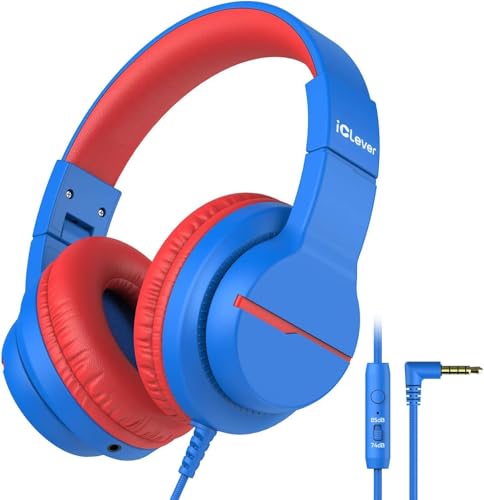
Pros
- Share port for a second listener
- In-line mic for online courses
- Ultra-soft earmuffs listed
Cons
- The listing gives one volume limit, 85dBA
The iClever HS19 is a wired, foldable set with an in-line microphone for online courses and voice calls. Its 40mm drivers provide stereo sound, and a share port lets a second listener plug in. The listing sets an 85dBA volume limit and describes ultra-soft earmuffs.
Best for: Siblings or classmates who want to listen together on one device.
15. HD mic on a cord: Aechorhy Over Ear

Pros
- Two volume modes: 85dB and 94dB
- Built-in HD mic
- Plush over-ear earmuffs
Cons
- The listing does not give a cord length
The Aechorhy kids headphones are a wired, foldable set with two safe volume modes, 85dB and 94dB. They use 40mm composite drivers, plush over-ear earmuffs and an adjustable headband. A built-in HD mic is listed for classes and voice chat.
Best for: Kids who take part in online classes and need a clear mic on a corded set.
16. Study or travel volume modes: Botesty Sound Kids

Pros
- Study and travel volume modes
- 4.9-foot braided cord listed
- In-line mic and controls
Cons
- A 4.9-foot cord limits how far a child can move from the device
The Botesty Sound kids headphones are wired with a 4.9-foot tangle-free and tear-resistant nylon braided cord. The volume limit switches between 85dB for study mode and 94dB for travel mode. An in-line mic and controls, a 90-degree swivel and a foldable structure are listed.
Best for: Families who want a school-ready set that also switches to a travel volume setting.
How to choose the best kids headphones
Start with volume. The listings in this roundup describe different approaches: some state a single fixed limit, some offer several levels, and some let you set a lower maximum. Read the exact figure on the listing, then follow the manufacturer’s manual for setup, charging and volume settings. If a manual is unclear, do not guess at the settings.
Next, decide on connection. Wired sets avoid battery charging but stay tethered to the device. Wireless sets allow movement, but they depend on charging. Check what each listing says about charging, and note whether the set also has a 3.5mm jack for a backup connection.
Fit and build matter for daily use. Look for an adjustable headband, soft ear cushions and foldable frames that fit in a bag. For wired sets, a braided cord is a useful sign of durability. Some kids like lights or character designs, but those features do not change how loud the sound gets, so keep the volume settings in mind.
Finally, check for recalls before you buy and after you give headphones to your child. The CPSC recalls page lists current product recalls. For general guidance on children’s health and hearing, see HealthyChildren.org. You can also find more buying guides in the Parenting Challenges section.
What to look for
- A volume limit stated in the listing, with the manual explaining how to set it
- Connection type: wired, wireless or both, and what the listing says about charging
- An adjustable headband and comfortable ear cushions
- Cord durability for wired sets, such as a braided cord
- A microphone and controls if calls or online classes matter
FAQ
Are these headphones safe for toddlers?
This roundup is based on manufacturer listings, not medical advice. Each listing states its own volume limit, so follow the manufacturer’s manual for setup and safe use. Check the CPSC recalls page regularly for any product safety notices.
Should I choose wired or wireless?
Wired sets do not need charging, but they stay connected to the device by a cord. Wireless sets allow more movement and are listed with Bluetooth connections. Many sets here offer both options, so check the listing for the exact connection type.
Do kids headphones need noise cancelling?
Noise cancelling is not required for most listening. Two listings name active noise cancelling: the JBL Junior 470NC and the Midola set. Choose it only if your child’s listening setting calls for it, and follow the manual for how to use the feature.
How do I compare volume limits?
Listings show different limits, such as a single 85dB or 85dBA setting, or several levels like 74, 85 and 94dB. Compare the exact figure each listing states, and confirm how the setting works in the manual before you rely on it.
References
- Amazon product listings and manufacturer specifications (accessed November 2026)
- HealthyChildren.org
- U.S. Consumer Product Safety Commission, Recalls