Quick answer
Our overall pick is the LearnWorx 101 Baby Flash Cards for its large set of 101 cards with games on the back. Other picks are great for interactive audio learning, extra durability, or specific skill-building like alphabet mastery.
Flash cards are a classic tool for building early vocabulary, but with so many options, it can be hard to know where to start. To help you choose, we compared manufacturer listings and specifications for 14 of the best toddler flash cards available. Our picks cover a range of needs, from large sets of first words to interactive talking cards and durable, rip-proof options.
Quick picks
- Best overall set: LearnWorx 101 Baby Flash Cards (see on Amazon)
- Best interactive talking cards: Airbition Talking Flash Cards (see on Amazon)
- Best rip-proof & waterproof: BenBen Rip Proof Flash Cards (see on Amazon)
- Best focused on alphabet: School Zone Alphabet Flash Cards (see on Amazon)
14 Best Toddler Flash Cards compared
| # | Product | Best for | Card Count | Card Size | Key Features |
|---|---|---|---|---|---|
| 1 | LearnWorx 101 Baby Flash Cards | Best overall flash card set | 101 cards | 5″ x 3.7″ | Games on reverse side, award-winning designs |
| 2 | BenBen Flash Cards (250 Images) | Best for a large set with real pictures | 250 images (125 cards) | 5″ x 3.5″ | Real pictures, 8 topics, water-resistant |
| 3 | TOYVENTIVE 250 Thick Flash Cards | Best for a massive vocabulary set | 250 cards | Not listed | Extra-thick, includes rings, real images |
| 4 | Melissa & Doug Ms. Rachel Textured Flashcards | Best for sensory and first word connection | 30 cards | 5″ x 7″ | Textured cards, sensory play, official Ms. Rachel |
| 5 | Scholastic First Words Flash Cards | Best basic first words set | Not listed | 3.33″ x 0.86″ (packaged) | Not listed |
| 6 | Airbition Talking Flash Cards | Best for interactive audio learning | 224 words (112 cards) | Reader: 4″ x 4″ | Talking reader, real sounds, rechargeable |
| 7 | Aullsaty Talking Flash Cards (Pink) | Best for interactive play with songs | 224 words (112 cards) | Reader: 4.2″ x 3.5″ | Talking reader, songs, sound effects, rechargeable |
| 8 | Skillmatics Flash Cards | Best for mastering essential first concepts | 50 cards | 5.4″ x 3.5″ | Thick material, realistic imagery, four core topics |
| 9 | Think Tank Scholar 5-Deck Set | Best comprehensive multi-deck set | 180 cards (5 decks) | 3.1″ x 5.2″ | Five subject decks, real-life photos, award-winning |
| 10 | School Zone Alphabet Flash Cards | Best focused on alphabet and phonics | 56 cards | 3.0″ x 5.575″ | Alphabet focus, parent guide, glossy finish |
| 11 | Carson Dellosa Toddler Flash Cards 4-Pack | Best multi-subject bundle | 216+ cards (4 packs) | 5.25″ x 3.25″ | 4-subject bundle, bonus game cards, glossy |
| 12 | ZazzyKid Flash Cards (54 PCS) | Best compact learning set | 54 cards | 3.5″ x 5″ (approx) | Laminated, four topics, vibrant pictures |
| 13 | TOYVENTIVE 60 Flash Cards with Rings | Best for organization and portability | 60 cards | Not listed | Includes rings, real photos, portable |
| 14 | BenBen Rip Proof Flash Cards | Best for durability and easy cleaning | 168 images (84 cards) | 5″ x 3.5″ | Rip-proof, waterproof, real images |
How we chose
We compared manufacturer listings and specifications on Amazon as of October 2026. We did not test or use any products hands-on. Our picks are based on comparing listed features like card count, themes, size, durability claims, and included learning activities.
Best flash cards for first words and vocabulary
These sets focus on building a broad vocabulary with many images and themes.
1. Best overall flash card set: LearnWorx 101 Baby Flash Cards

Pros
- Large set of 101 cards with many themes
- Includes games and questions on the back of each card
- Bright, colorful illustrations
Cons
- The listing does not mention specific durability features like lamination.
The LearnWorx set includes 101 large flashcards sized 5″ x 3.7″. The cards feature colorful illustrations of first words across categories like animals, food, and household objects. On the reverse side of each card is a fun game or question, such as “What color is the car?” or a spot-the-difference activity, designed to help develop speech recognition and counting skills.
Best for: Families looking for a large, versatile set of first words cards with interactive games on the back.
2. Best for a large set with real pictures: BenBen Flash Cards (250 Images)

Pros
- Large set with 250 real images
- Extra-thick, water-resistant coating
- Includes interactive questions on some cards
Cons
- The listing does not mention if cards are bound or come with rings.
This BenBen set includes 125 double-sided cards, offering 250 images across 8 subjects like letters, numbers, animals, and shapes. The cards use real, vivid pictures and have some interactive questions on the back. They are made from extra-thick, BPA-free coated cardboard with rounded corners and are listed as water-resistant and easy to wipe clean.
Best for: Parents who want a large vocabulary set featuring real photographs instead of illustrations.
3. Best for a massive vocabulary set: TOYVENTIVE 250 Thick Flash Cards

Pros
- Very large set of 250 thick cards
- Includes rings for organization
- Uses real images, covers sight words
Cons
- A very large set may be difficult to sort through for a single learning session.
This TOYVENTIVE set is a large collection of 250 thick, laminated flashcards that come with rings. The cards cover numbers, colors, shapes, animals, food, first words, and sight words using real images. They are described as extra-sturdy and designed to support early speech and memory.
Best for: Building an extensive vocabulary with a very large set of durable cards.
4. Best for sensory and first word connection: Melissa & Doug Ms. Rachel Textured Flashcards

Pros
- Includes varied textures for sensory play
- Official Ms. Rachel product with a learning guide
- Features peek-a-boo elements and a mirror
Cons
- Smaller set of 30 cards.
This official Ms. Rachel set has 30 double-sided cards designed to connect verbal, visual, and sensory cues. The cards feature first words and include various textures like rough, smooth, bumpy, soft, and fuzzy, as well as peek-a-boo surprises and a mirror. The set includes a learning guide with play ideas.
Best for: Engaging multiple senses (touch, sight, sound) to reinforce first word learning.
5. Best basic first words set: Scholastic First Words Flash Cards

Pros
- From the Scholastic brand
Cons
- The listing provides very few details on card count, features, or images.
This is a straightforward set of First Words Flash Cards from Scholastic. The listing provides basic dimensions but does not detail the number of cards, specific features, or images used.
Best for: A simple, no-frills set of first words cards from a trusted educational brand.
Best interactive and talking flash cards
These electronic options combine visual cards with audio for a multisensory learning experience.
6. Best for interactive audio learning: Airbition Talking Flash Cards

Pros
- Interactive audio with 224 words
- Rechargeable battery with up to 4-hour life
- Screen-free, portable design
Cons
- Requires charging the electronic reader.
The Airbition Talking Flash Cards include a card reader and 224 words across 112 double-sided cards. The reader speaks words in a standard American accent when a card is inserted and makes real animal sounds. It has a repeat button, a 5-level volume control, and a rechargeable battery that lasts up to 4 hours. The listing states it is screen-free.
Best for: Toddlers who learn well with audio reinforcement and for use as a speech therapy tool.
7. Best for interactive play with songs: Aullsaty Talking Flash Cards (Pink)

Pros
- 224 words plus 3 songs
- Includes sound effects for interactive play
- Lightweight, portable, and rechargeable
Cons
- Requires charging the electronic reader.
The Aullsaty set includes a card reader and 112 double-sided cards with 224 words across 12 themes. The reader says the word when a card is inserted and includes fun sound effects. It also plays 3 classic English songs. The device is lightweight, portable, and USB rechargeable.
Best for: Combining vocabulary learning with musical play and sound effects.
Best flash cards for specific skills
These sets are designed to teach particular concepts like letters, numbers, shapes, and colors.
8. Best for mastering essential first concepts: Skillmatics Flash Cards

Pros
- Thick, sturdy, non-bendable cards
- Realistic imagery for clear learning
- Perfect size for small hands
Cons
- Smaller set of 50 cards focused on four topics.
This Skillmatics set has 50 thick, double-sided flash cards designed to be non-bendable and durable. The cards use realistic imagery to teach letters, numbers, shapes, and colors. They are sized at 5.4 inches tall and 3.5 inches wide with large fonts, designed for little hands.
Best for: Focusing on the core early learning concepts of letters, numbers, shapes, and colors.
9. Best comprehensive multi-deck set: Think Tank Scholar 5-Deck Set

Pros
- Five decks covering many subjects (180 cards total)
- Jumbo-sized cards with bold lettering
- Uses real-life photos on card backs
Cons
- The large number of cards may be overwhelming for younger toddlers.
This award-winning set includes five complete decks with 180 jumbo-sized cards (3.1” x 5.2”). The decks cover alphabet, first words & opposites, colors & shapes, numbers & counting, and rhyming. The cards are two-sided with bold lettering on the front and corresponding real-life photos on the back.
Best for: Preschool and kindergarten readiness with a wide range of subjects in one purchase.
10. Best focused on alphabet and phonics: School Zone Alphabet Flash Cards

Pros
- Dedicated to alphabet learning (56 cards)
- Includes both uppercase and lowercase letters
- Parent card with game instructions
Cons
- Focuses only on the alphabet, not other concepts.
This School Zone set contains 56 glossy cards focused on the alphabet. It includes 26 uppercase and 26 lowercase letter cards, plus index and parent cards. The cards are large (3.0″ x 5.575″) with bold illustrations and rounded corners. The parent card provides instructions for games and activities.
Best for: Concentrated practice on uppercase and lowercase letters and early phonics.
11. Best multi-subject bundle: Carson Dellosa Toddler Flash Cards 4-Pack
Pros
- Four subject packs in one (216+ cards)
- Bonus resource cards with game ideas
- Glossy finish, double-sided cards
Cons
- The listing does not mention card thickness or specific durability features.
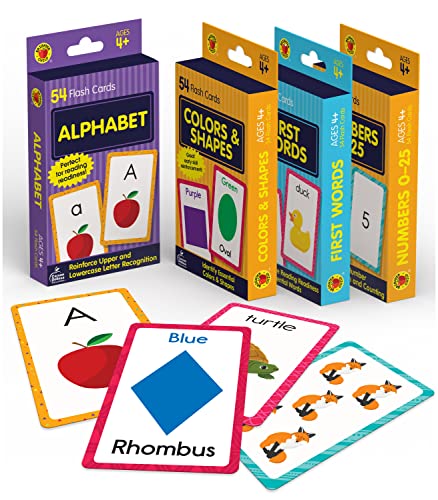
This Carson Dellosa bundle includes 4 packs of flash cards: Alphabet, Numbers 0-25, Colors & Shapes, and First Words, for a total of 216 cards. The cards are double-sided with a glossy finish and rounded edges. Five bonus resource cards provide additional phonics and math games.
Best for: Getting a complete library of core learning topics in one bundle.
12. Best compact learning set: ZazzyKid Flash Cards (54 PCS)

Pros
- Covers four key topics in one set
- Laminated for durability
- Includes both lowercase and uppercase alphabet
Cons
- The listing does not mention card size or thickness specifics.
The ZazzyKid set includes 54 double-sided cards covering alphabet (lowercase and uppercase), numbers, colors, and shapes. Each card has a lamination layer for durability. The cards feature vibrant pictures and corresponding words.
Best for: A compact, well-rounded set that covers the key early learning topics.
13. Best for organization and portability: TOYVENTIVE 60 Flash Cards with Rings

Pros
- Cards are held on three durable rings
- Uses real photos
- Designed for portability and organization
Cons
- The listing does not mention card thickness or lamination.
This TOYVENTIVE set includes 60 flashcards organized on three durable rings. The cards cover ABCs, numbers, shapes, and colors and use real photos. The rings are designed to keep the cards together for travel and everyday use.
Best for: Keeping cards organized and portable for learning on the go.
Best durable and travel-friendly flash cards
These cards are built to last and are easy to take on the go.
14. Best for durability and easy cleaning: BenBen Rip Proof Flash Cards

Pros
- Listed as rip-proof, waterproof, and easy to wipe clean
- Uses real images
- Durable, non-toxic materials
Cons
- The listing does not mention included storage or rings.
This BenBen set has 84 double-sided cards (168 images) covering 8 subjects. The cards are made from durable, non-toxic, BPA-free materials and are specifically listed as rip-proof, waterproof, indestructible, and easy to wipe clean. They are sized at 5” x 3.5” with large fonts and use real images.
Best for: Toddlers who are rough on toys or for families who want cards that are easy to sanitize.
How to choose the best toddler flash cards
Choosing the right flash cards depends on your toddler’s age, interests, and how you plan to use them. The best sets grow with your child, offering new challenges as their skills develop.
What to look for
- Learning Goals: Decide if you want cards for general vocabulary, specific skills (like ABCs), or interactive audio learning. Sets like the Skillmatics cards focus on core concepts, while talking cards add a sound dimension.
- Durability: Toddlers aren’t gentle. Look for terms like “thick,” “sturdy,” “laminated,” “rip-proof,” or “water-resistant.” Cards that are easy to wipe clean are a practical bonus.
- Engagement: Features beyond simple pictures can maintain interest. This includes games on the back of cards, different textures, or, for electronic sets, sounds and songs. Interactive elements can turn a learning activity into a fun game.
- Size and Usability: Cards should be large enough for small hands to hold easily (often around 5×3.5 inches). Rings or boxes for storage help keep sets organized and make them portable for car rides or waiting rooms.
Remember, the goal is to make learning playful. Follow your child’s lead, keep sessions short, and mix flash cards with other language development games. Always supervise play, especially with cards that have small detachable parts like rings.
FAQ
What age are flash cards good for?
Flash cards can be introduced around 12 to 18 months for simple picture recognition and first words. As toddlers grow, around ages 2-4, they can use them for more complex learning like letter sounds, counting, and answering questions on the cards. Always choose cards that match your child’s current developmental stage.
Are talking flash cards worth it?
Talking flash cards can be a valuable tool, especially for auditory learners or as a supplement to speech therapy. They provide correct pronunciation and can make learning more interactive with sounds and songs. However, they require batteries or charging, and simple card sets often offer more flexibility for creative play and parent-child interaction.
How do I use flash cards with my toddler without it feeling like a drill?
Keep it fun and game-like. Use the cards for quick matching games, hide them around the room for a seek-and-find, or use them as prompts during play. Follow the activity ideas often included with the cards. The key is to follow your toddler’s interest and stop before they get frustrated. For more ideas, see our guide on language development games.
Should flash cards use cartoons or real pictures?
This depends on your goal. Colorful cartoons can be engaging and help with abstraction. Real photographs, however, can help toddlers make a clearer connection between the card and the actual object they see in the real world. Many children benefit from a mix of both styles.
References
- Amazon product listings and manufacturer specifications (accessed October 2026)
- HealthyChildren.org from the American Academy of Pediatrics
- Language Games
- Language Development Games to Boost Toddler Vocabulary